
American lawmakers and experts called for cutting off aid to the country and listing it as a state sponsoring terrorism.

The joint statement issued after Prime Minister Narendra Modi and President Barack Obama's first-ever summit is high on intent and ambition. Notably missing from the statement is India's refusal to be America's partner in its war against ISIS.

The central government has drafted a law to restrict wombs for hire, and there is much to be said on all sides.
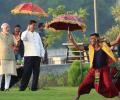
A sensational interview on India-China ties, with the man most qualified to answer.

By hosting the 10 ASEAN leaders on Republic Day, India amply demonstrated that ASEAN is a central pillar of its Act East policy. But is India 'central' for ASEAN, asks Dr Rahul Mishra.

'If the dimensions of the strategic partnership worked out by India and the US seem like a grand alliance targeted at you-know-who, China had better realise that it has fathered it,' says B S Raghavan, a long time observer of China.

'Pakistan has worsted India in the Afghan proxy war and the defeat becomes a template of regional politics,' points out Ambassador M K Bhadrakumar.

An influential Hindu organisation in the United States has slammed a group of lawmakers for introducing a resolution in the House of Representatives on record of India's religious freedom arguing that it is grossly inaccurate and aims to provoke.

The Security Council as it is today is unable to bring peace and security in the world and so there is reason for countries like India to become members of the Council, Ambassador Asoke Kumar Mukerji tells Sheela Bhatt/Rediff.com.
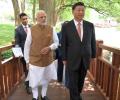
There is a sense of relief in Beijing that Modi will be at the helm of affairs in Delhi at a critical juncture in the geopolitics of the region, says Ambassador M K Bhadrakumar.

Moon Jae-in's visit will play a crucial role in exploring complementarities between India's Act East policy and South Korea's New Southern policy, says Dr Rahul Mishra.

Pak seeks US help to ease tensions with India.

'Chinese leaders rarely receive their foreign guests in cities other than Beijing. Such respect for India!' 'Does it mean that Modi could replicate "the warmth and unconventional way" by sending Indian troops into Tibet, as Xi did in Chumur (Ladakh) when he arrived in India? Of course, Indians are far too polite to do so,' says Claude Arpi.

Prime Minister Narendra Modi on Thursday address Members of the British Parliament in London where he promised to open more doors of cooperation between the two countries and delved on issues like terrorism and United Nations reforms.

In bilateral interfaces relations with China have also to be given due weight, opines Premvir Das

'We're going to see a defence relationship that really takes off -- now that India is a major defence partner of the US, the sky is the limit for arms sales.' 'The economic partnership will lag behind the security relationship, but the meeting and joint statement give cause to believe that it will progress more robustly than many of us would have expected.'

Mr Prabhu has a big challenge ahead in implementing trade reforms to regain the lost export momentum, says Jayanta Roy.

This is the joint statement issued by the ministry of external affairs on the visit of US President Barack Obama to India.
'Pakistanis are very clever in manipulating us,' former Bush administration official tells US lawmakers.

'If Facebook were a country, it would be the third most populous one and the most connected.'

The strategic pacts were inked after the summit between Prime Minister Narendra Modi and his Japanese counterpart Shinzo Abe during which they also discussed international and regional issues of mutual importance including UN security reforms.

A red fox in a derelict schoolroom, a Bengal Tiger in the forests of Bhutan and walruses are just a few of animals featured in the photos shortlisted for this year's Wildlife Photographer of the Year. While we wait for the results to be announced, here are some of the contenders in the contest.

India should plan its strategies on the assumption that the rightward swing will stay and the West will retreat into an economic fortress, says Nitin Desai.

Bunker Roy, founder of the Barefoot College at Tilonia in Rajasthan, was awarded the Clinton Global Citizen Award at a ceremony in New York on September 25.


'The book has immense value because it reveals the inner workings of the think-tank which appears to provide facts and insights to Modi, though he himself takes the final decisions and articulates them in his characteristic rhetorical style,' says Ambassador T P Sreenivasan.
A new logo can harm image than doing good, say experts.

'Pluralism is a fundamental fact of Indian life,' Colonel Anil A Athale (retd) tells members of the US Congress. 'Indians created a secular/plural State because that is what the majority believes in and not the other way round.'
We are witnessing a new phase where business leaders are realising globalisation has to take into account national identities and cultures, says Claude Smadja.

The India that needs strategic alliances, defence cooperation and engaging meaningfully with neighbouring countries is quietly moving ahead with confidence, says Tarun Vijay

'Ensuring through diplomatic means and in conjunction with strategic partners that India will not be required to fight a simultaneous two-front war with China and Pakistan.' Brigadier Gurmeet Kanwal (retd) lists what India must have in its national security strategy.

'Pakistan's negativism should be seen as the reason for India losing interest in SAARC.'

'Devyani -- she is a public servant and her personal life has already received far too much attention -- and her ambitious father now need to retreat to the background so that wiser diplomatic heads restore sanity to India-US relations as India prepares for parliamentary elections,' says Ambassador K C Singh.

The President was apparently unaware of the Narendra Modi visa ban controversy till April. Aziz Haniffa/Rediff.com has the scoop.

In spite of irritants and hiccups in the relationship, a few deliverables are expected of the prime minister's visit to China, says Rup Narayan Das.

'We use the word "historic" perhaps too much, but the prime minister's visit certainly was historic in so many ways.'

Praising the US for turning barriers into bridges of partnership, he said that America had stood with India when the support was needed the most, like when terrorists attacked Mumbai in November 2008 and in other economic endeavours as well
New Delhi and Beijing are the only two regional capitals that have commented on US President Donald Trump's speech on August 21 outlining the way forward in Afghanistan. The Indian foreign ministry statement was effusive in praise, while the Chinese statement has been one of cautious and guarded hope. Delhi has identified itself with Trump's Afghan strategy, whereas the Chinese stance is calibrated -- observant and objective, keeping a distance, says Ambassador M K Bhadrakumar.

A look at the life and times of maverick businessman Chinnakannan Sivasankaran
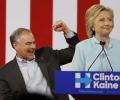
Rediff.com reproduces this 2014 interview with Tim Kaine where in he discusses the new opportunities to foster Indo-US trade and the improvement in ties.
